
Four marks stand one above the other at the top right of an open book. There is a mountain-like stroke, a set of bars, two circles linked together, and another hill-like form crowned with circles. On the facing page a stranger holds a square box. Here is a question you can ask without deciphering a thing. Who first saw those marks? National Archives of Japan, Hirokata zuihitsu, frame 2

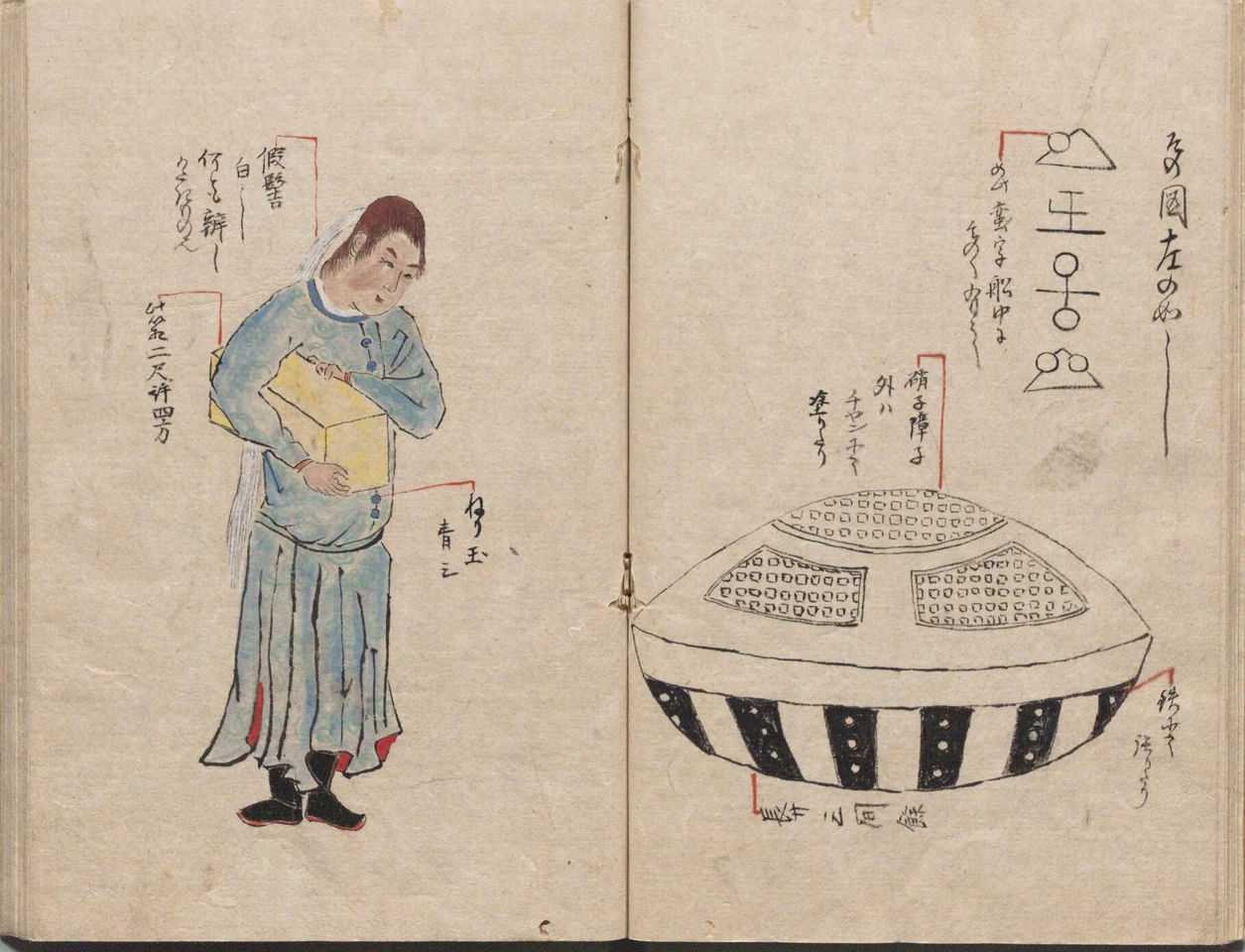
National Archives of Japan, Hirokata zuihitsu, frame 2, with margins trimmed. Notice that the artist placed the signs outside the drawn hull. Colour manuscript
Before reading the signs, find the subject of the sentence
The account in Toen shōsetsu begins around noon on the twenty-second day of the second lunar month of 1803. People at a beach called Harayadori in Hitachi Province see something offshore. The subject of the sentence is urabito-ra, the people of the shore. They row out and tow in a vessel as round as a lidded incense box, glazed above and plated with iron below. When they gather to look, there is a woman inside. She and the people on the beach share no language. Text in the Meiji-period printed edition, frames 142–143 · Manuscript of Toen shōsetsu, collection 11, frame 35, Showa Women’s University Library
By the time we reach the signs, the storyteller has taken a step back. There were said to have been many strange characters in the boat. The story has people seeing the vessel. It supplies no name for the person who first spotted the writing, took out paper and copied it in a particular orientation. On the page the signs sit neatly in a space above the vessel. That arrangement makes them legible to a reader. It gives us no way of measuring their spacing on an actual plank. Illustration, 1891 edition · Closing passage on the signs
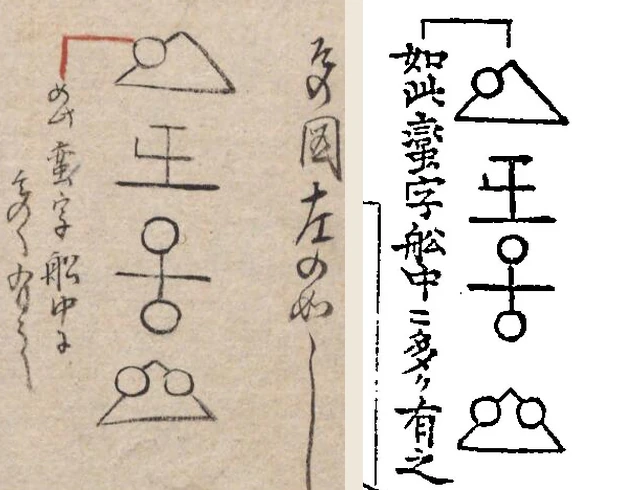
Left, Hirokata zuihitsu, National Archives of Japan. Right, Toen shōsetsu in the 1891 Hyakka setsurin, National Diet Library. The two sets were enlarged separately. Their resemblance cannot establish two independent sightings on the beach. Manuscript · Printed edition
Did anyone open the box?
The woman keeps everyone away from a box about two shaku, or 60 centimetres, square. In Toen shōsetsu an elder introduces a tale he has heard before. A foreign princess had been cast adrift with the head of the man she loved in a box. Perhaps, the elder reasons, something similar explains this woman’s box. Turn back to the picture. Her arms are over the lid. We cannot see inside. A severed head, one of the story’s most vivid details, has entered it without a single witness opening the box. Toen shōsetsu, frames 143–144 · National Archives exhibition notes
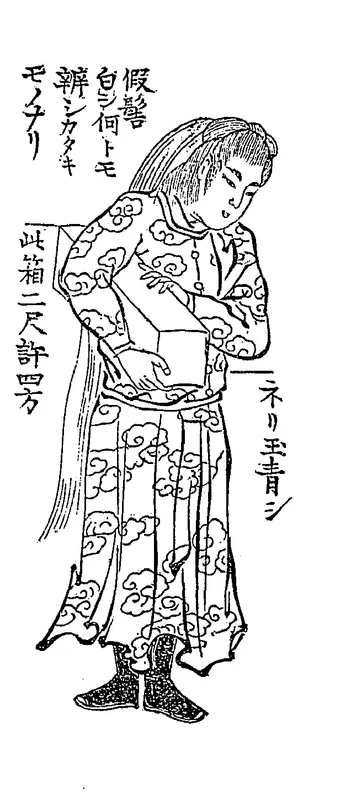
Detail of the woman and box, Hyakka setsurin, vol. 9, frame 143, National Diet Library. Full page
Something similar happens with her nationality. The writer thinks marks like these had appeared on a British ship off Uraga. Several possible places of origin follow. This is reasoning after the fact. The writer offers no reading for each sign and describes no conversation in which the woman identifies her country. Closing passage, frame 144
People named in books, people unnamed on the shore
The name of the celebrated writer Kyokutei Bakin can distract us here. His Edo circle collected curious stories in 1825, twenty-two years after the date the account assigns to the landing. The contribution bears the name Kinreisha. The National Archives catalogues the manuscript preserved in Hirokata zuihitsu under Bakin’s son, Takizawa Okitsugu. Yashiro Hirokata collected manuscripts brought to him by friends. The people we can name with some confidence are the writers and collectors through whose hands the story passed. National Archives catalogue and author attribution · Library record for collection 11 · Transcription and contributor’s name
Turn to another notebook. In Komai Norimura’s Ōshuku zakki the boat and the woman are drawn one above the other. The round hull has a conspicuous square opening and long upright lines across its lower half. Now try the broadside in Funabashi’s West Library. Here the boat appears offshore in the second month but only comes ashore during a storm in the eighth. The versions disagree even about what happened on the dates they give. Ōshuku zakki, vols. 13–14, frame 116 · Funabashi’s broadside and modern Japanese rendering
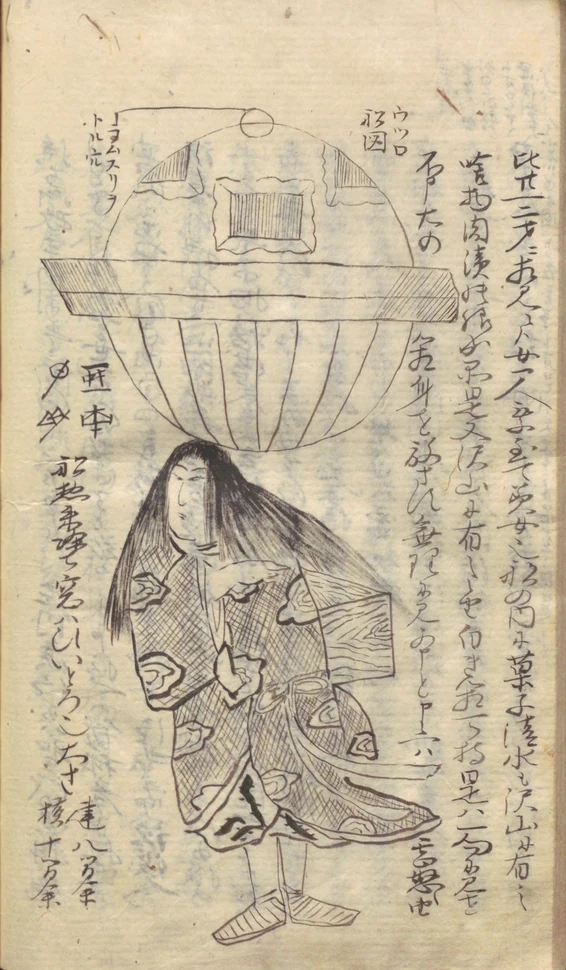
The right-hand page of Ōshuku zakki, frame 116, National Diet Library. Even the outline of the vessel changes when set beside the drawing in Hirokata zuihitsu. Complete spread
An Edo reader tried to check
The Hyōryū kishū held by the Iwase Bunko Library in Nishio ends in the manner of a report. The boat was inspected, characters like these were found, and the matter was reported. In that case, might the receiving office have a record? Someone in Edo-period Japan had precisely that thought. In his Ibun zatcho, the compiler Suzuki (鈴木甘井) says he sent to find out whether the authorities had received a report. A note records word from Kitamura Hisatomo that the story was false. At last there is a named informant. What he supplies is a doubt about the whole affair. Iwase Bunko’s transcription · Jōetsu City’s transcription and modern Japanese, p. 2
None of these sources gives us a name for the person on the beach who first copied four signs. Yet a track survives. Someone copied a picture. Someone looked for a parallel on a foreign ship. Someone tried to check the official paperwork. The rumour of an unknown script travelled far enough to preserve the words of someone who doubted it. That voyage is easier to follow than the boat’s.